










Practical questions that separate platforms that fit from ones you'll regret in 18 months.
Buying an HRIS is one of the highest-stakes software decisions an HR leader makes. The platform shapes daily workflows for every employee. Migration costs are real. Switching costs are even higher. And, vendor demos are designed to highlight strengths while quietly skipping over the parts that don’t work as well.
Most evaluation processes spend too much time on feature lists and not enough on the questions that determine whether the platform will still fit your needs in three years. Here’s a checklist that focuses on what actually matters.
Architecture and Integration
Most HRIS pain shows up at the seams between modules. Important questions to ask:
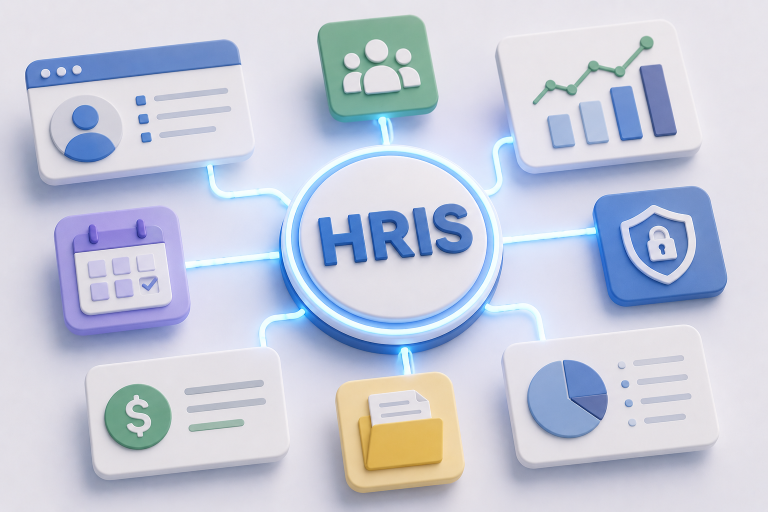
- Is there a single employee record across payroll, scheduling, time, documents, and learning, or are these separate systems with connectors?
- When data changes in one module, does it update everywhere automatically?
- How are integrations with outside systems (accounting, benefits brokers, ERP) handled?
- If a feature you need doesn’t exist, does the vendor build it in-house or rely on a third-party roadmap?
Compliance and Multi-Jurisdiction Support
Compliance is the area where vendors most often overpromise. Consider:
- Is multi-state payroll filing native, or does it require a third-party tax service?
- Are SUI rates managed automatically per state?
- How are reciprocity agreements handled?
- Does the system support union compliance logic, minimum staffing rules, and certification-driven scheduling eligibility?
- How do compliance updates ship; automatically, or as configuration tasks for your team?
Native compliance support is one of the cleanest ways to separate enterprise-grade platforms from lighter tools dressed up for sale.
Support and Issue Resolution
Software is only as good as the team standing behind it. Ask:
- What’s the average response time on a support call?
- Is support U.S.-based or routed offshore?
- Do support agents have direct access to the engineers who built the feature, or do tickets get queued?
- What’s the resolution rate on first contact?
VCS HR answers calls in under 20 seconds with a 100% resolution rate. That’s the bar to ask any vendor to match.
Scalability Without Re-Platforming
The HRIS that fits at 50 employees should still fit at 500. Ask:
- What does the largest deployment of this platform look like?
- What happens when we add a module? Is it a configuration change or a new contract?
- Are there scale ceilings that would force a migration in three to five years?
Implementation and Time-to-Value
A long implementation is a real cost. Ask:
- What’s a realistic implementation timeline for an organization our size?
- Who owns implementation — vendor, partner, or our team?
- What’s the typical time from contract to first live payroll?
- What happens if the implementation slips?
Total Cost (Including the Hidden Pieces)
Sticker price is rarely the real cost. Ask:
- Are modules priced individually, or is the platform bundled?
- What are the per-employee, per-state, and per-module fees?
- Are tax filings included or charged separately?
- What’s the cost of a future migration if the platform stops fitting?
The right HRIS isn’t the one with the longest feature list. It’s the one that still fits in three years.

Want a vendor that can answer every question on this checklist?
Schedule a demo or HRIS software evaluation with VCS HR and see a platform that supports payroll, scheduling, time, documents, learning, and applicant tracking all on one employee record. Visit vcshr.com to get started.